I sent out this blog post exclusively to the email list in February. If you’d like to read my articles before they’re shared here on the blog and receive other exclusive content, make sure to subscribe to the email newsletter.
December and January were a whirlwind of activity for me: first the holidays, and then diving back into my work at the marketing agency. In my spare time, I’ve tried to make progress on writing projects and other creative endeavors. I’ll share more about that in upcoming newsletters.
I hope your start to the new year has been less hectic than mine. May these first months of 2026 bring you many new ideas for your stories!
At the start of the year, it’s become a tradition for the blog that I share my favorite passages from books I read the previous year. These are passages that struck me with their eloquence. I love writing them down so I can further study the author’s techniques for structure and style.
Without further ado…
1. The Vicomte de Bragelonne by Alexandre Dumas
Last year, I finished reading through Alexandre Dumas’s marvelous series of Musketeers books in French (the d’Artagnan Romances). I loved the first three books in the series best: The Three Musketeers, Twenty Years After, and The Vicomte de Bragelonne. The musketeers have smaller roles in the later books in the series.
While reading The Vicomte de Bragelonne, I was struck by this wonderfully long but masterfully written sentence.
It was nearly six o’clock; the road was fresh and pleasant; tall trees with their foliage still inclosed in the golden down of their buds, let the dew of morning filter from their trembling branches, like liquid diamonds; the grass was bursting at the foot of the hedges; the swallows having returned only a few days since, described their graceful curves between the heavens and the water; a breeze, laden with the perfumes of the blossoming woods, sighed along the road, and wrinkled the surface of the waters of the river; all these beauties of the day, all these perfumes of the plants, all these aspirations of the earth towards heaven, intoxicated the two lovers, walking side by side, leaning upon each other, eyes fixed upon eyes, hand clasping hand, and who, lingering as by a common desire, did not dare to speak, they had so much to say.
Dumas usually focuses more on action and less on description, so when he does write a descriptive paragraph, it really stands out. I love how this sentence builds and builds with vivid imagery of the landscape, until it zooms in on the characters and finally their emotions.
2. Moby-Dick; or, The Whale by Herman Melville
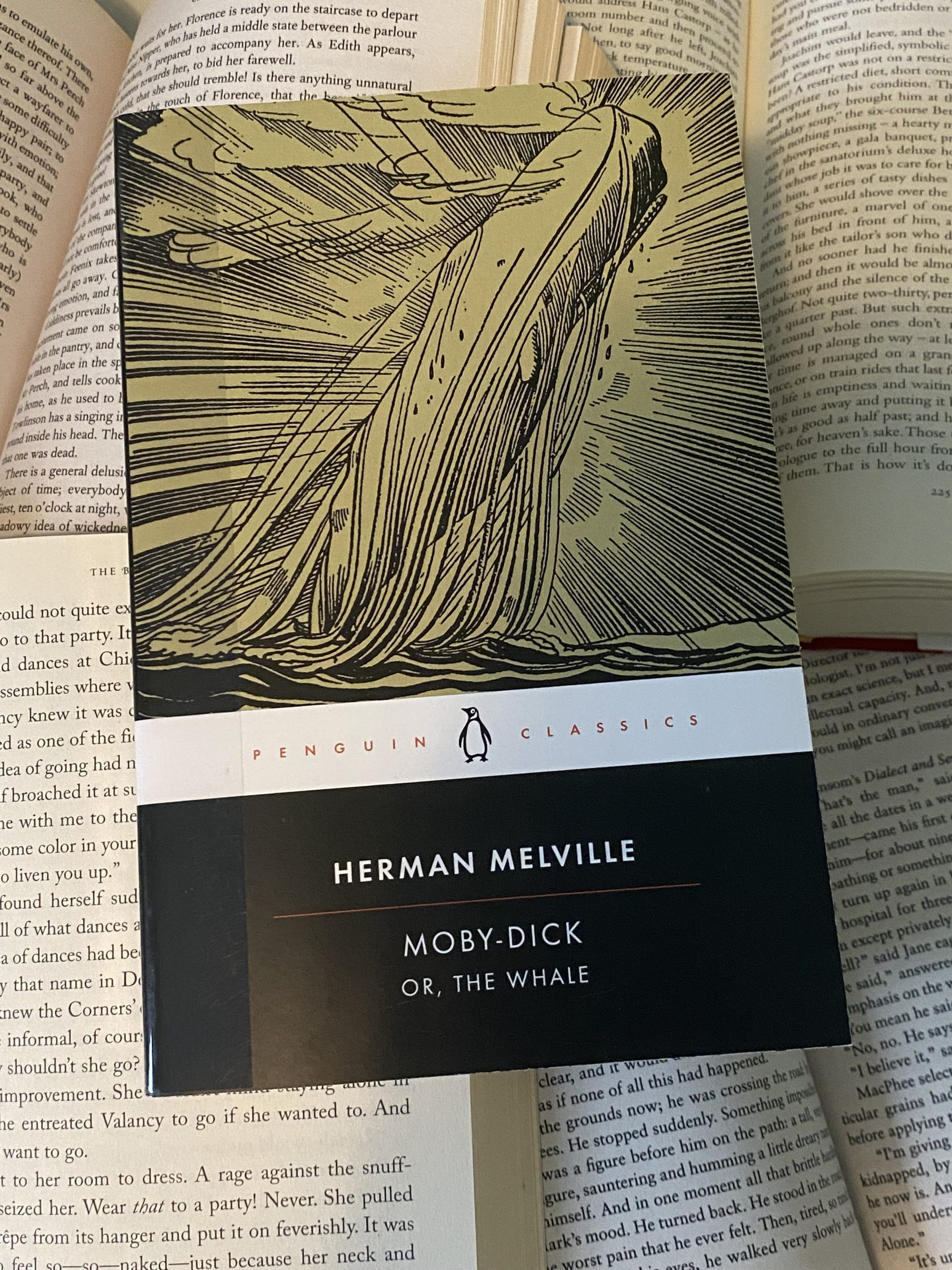
2025 was the year I finally read Moby-Dick by Herman Melville: the tale of Captain Ahab and the crew of The Pequod and their obsessive pursuit of the whale Moby Dick. I’ve had this book on my to-read list for ages but had put it off because many people called it a slog with endless chapters categorizing whales.
I’m very glad I picked it up despite those reviews. It has one of the most unique styles of a book I’ve ever read. One chapter reads like a narrative, the next like a beautifully written nature study, the next a scene from a play, the next a travelogue, the next pure poetry. I was blown away by numerous lyrically written passages.
Here’s one that I jotted down.
Some days elapsed, and ice and icebergs all astern, the Pequod now went rolling through the bright Quito spring, which, at sea, almost perpetually reigns on the threshold of the eternal August of the Tropic. The warmly cool, clear, ringing, perfumed, overflowing, redundant days, were as crystal goblets of Persian sherbet, heaped up—flaked up, with rose-water snow. The starred and stately nights seemed haughty dames in jewelled velvets, nursing at home in lonely pride, the memory of their absent conquering Earls, the golden helmeted suns! For sleeping man, ’twas hard to choose between such winsome days and such seducing nights. But all the witcheries of that unwaning weather did not merely lend new spells and potencies to the outward world. Inward they turned upon the soul, especially when the still mild hours of eve came on; then, memory shot her crystals as the clear ice most forms of noiseless twilights.
I love that synonym comparing the beautiful days to crystal goblets of Persian sherbet. Honestly, it was difficult to choose only one quote from this book. I jotted down many more.
If you’re interested in reading Moby Dick, I recommend this website that presents the text with helpful accompanying annotations.
3. Dombey and Son by Charles Dickens
I’ve been reading through all of Charles Dickens’s novels, picking one to read each summer. This past summer, I chose Dombey and Son, one of his lesser known books. If you’re new to Dickens, I’d recommend his more famous books before this one. But this one was an engrossing read too. And, of course, Dickens is a masterful writer. I always learn so much about writing after studying one of his stories.
Here’s a passage that I highlighted. One of the characters, Paul Dombey, attends a school run by Doctor Blimber. The course of study focuses on cramming the students full of knowledge (especially Ancient Greek and Latin), rather than ensuring they fully understand what they are learning. Dickens uses a marvelous extended metaphor of a “hot-house,” comparing the students to plants, to describe the arduous conditions of the school.
In fact, Doctor Blimber’s establishment was a great hot-house, in which there was a forcing apparatus incessantly at work. All the boys blew before their time. Mental green-peas were produced at Christmas, and intellectual asparagus all the year round. Mathematical gooseberries (very sour ones too) were common at untimely seasons, and from mere sprouts of bushes, under Doctor Blimber’s cultivation. Every description of Greek and Latin vegetable was got off the driest twigs of boys, under the frostiest circumstances. Nature was of no consequence at all. No matter what a young gentleman was intended to bear, Doctor Blimber made him bear to pattern, somehow or other.
This was all very pleasant and ingenious, but the system of forcing was attended with its usual disadvantages. There was not the right taste about the premature productions, and they didn’t keep well. Moreover, one young gentleman, with a swollen nose and an excessively large head (the oldest of the ten who had “gone through” everything), suddenly left off blowing one day, and remained in the establishment a mere stalk.
4. A Christmas Carol by Charles Dickens
After enjoying Dombey and Son, I decided to re-read A Christmas Carol at the end of the year. I shared several months ago that I’ve been working on a writing resource that explores how famous authors write memorable characters. I was sure that studying this Dickens classic again would reveal many character creation techniques, and I was not disappointed.
One of my favorite passages in the book is Dickens’s description of Ebenezer Scrooge.
Oh! But he was a tight-fisted hand at the grindstone, Scrooge! a squeezing, wrenching, grasping, scraping, clutching, covetous, old sinner! Hard and sharp as flint, from which no steel had ever struck out generous fire; secret, and self-contained, and solitary as an oyster. The cold within him froze his old features, nipped his pointed nose, shrivelled his cheek, stiffened his gait; made his eyes red, his thin lips blue; and spoke out shrewdly in his grating voice. A frosty rime was on his head, and on his eyebrows, and his wiry chin.
I love the rhythm of this passage, especially the barrage of adjectives. Dickens first describes Scrooge’s personality, and then shows how that affects numerous aspects of his appearance: his nose, cheek, gait, eyes, lips, voice, and hair. All of these details help to reinforce Scrooge’s miserliness
5. “Bartleby, the Scrivener” by Herman Melville
It was difficult choosing the last passage to share here as I read over twenty books in 2025. But I’ve decided to highlight another Melville quote. This is technically from a short story, not a book: “Bartleby, the Scrivener: A Story of Wall Street” by Herman Melville.
It tells the tale of a lawyer who hires a new clerk, Bartleby. At first, he is attentive at his work, copying documents for long hours. I love how Melville first introduces the reader to Bartleby, describing the character as gorging himself on the legal documents.
At first Bartleby did an extraordinary quantity of writing. As if long famishing for something to copy, he seemed to gorge himself on my documents. There was no pause for digestion. He ran a day and night line, copying by sun-light and by candle-light. I should have been quite delighted with his application, had he been cheerfully industrious. But he wrote on silently, palely, mechanically.
This sets up a powerful contrast to Bartleby’s rebellion later on. Just as he was fanatical in completing his work at the start of the story, he suddenly becomes fanatical in avoiding work.
He responds to his employer’s requests to complete certain tasks with the simple phrase, “I would prefer not to.” Like Dickens’s A Christmas Carol, it’s a fantastic story to study for techniques for powerful character development.
I hope these passages provide inspiration and strategies for your own writing.
Have you read any of these books? What were your favorite books read last year? Let me know in the comments.
If you enjoyed this post, be sure to share it on social media or with a fellow writer who you think would enjoy it too. And if you’d like to support the blog, you can buy me a virtual coffee.
Thank you! Wishing you much success with your writing projects this year! God bless.


Leave a Reply