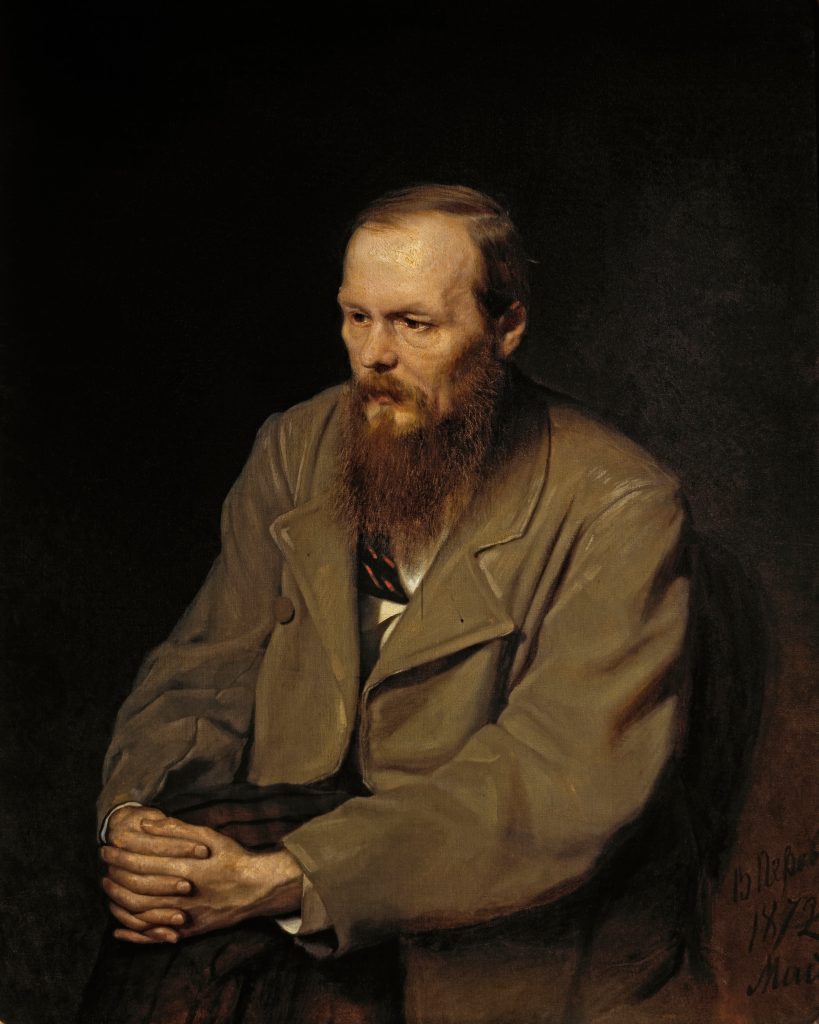
While reading The Idiot by Fyodor Dostoevsky, I was pleasantly surprised at the opening to part four where Dostoevsky briefly pauses from the narrative to reflect on how authors can write interesting characters.
Since I’ve been studying the work of famous authors to create a resource on crafting memorable characters, I found this digression by Dostoevsky quite intriguing.
Dostoevsky sorts characters into three categories:
- The dramatic type
- The limited ordinary type
- The clever ordinary type
Let’s look at each of these categories and see how we can use them to strengthen the development of our own characters. The quotations come from the Peaver and Volokhonsky translation of the novel.
Type No. 1: The Dramatic Type
The dramatic type is the larger than life, exceptional character. It is a person who will react to life in an exaggerated and unexpected way.
According to Dostoevsky, this type is the favorite of writers. I imagine this type, for example, as an author choosing a miser as their protagonist. Then the author exaggerates him into the wickedest miser ever to live as Charles Dickens did with Ebenezer Scrooge.
Arthur Conan Doyle wrote Sherlock Holmes as the most brilliant detective. Shakespeare’s Macbeth is willing to do anything to achieve power.
Dostoevsky observes,
Writers in their novels and stories for the most part try to take social types and present them graphically and artistically—types which in their full state are met with extremely rarely in reality and which are nonetheless almost more real than reality itself.
Dostoevsky gives the example of a character in a Gogol play, a bridegroom who escapes out of a window rather than get married.
In real life, there may be many reluctant bridegrooms who could picture themselves escaping through a window or wishing that they had after the ceremony, but they would never go through with it in real life.
This is what makes the fictional character captivating. Even though they are larger than life, the reader can still relate to these characters as they represent the extreme of universal emotions we have all experienced.
However, Dostoevsky reasons that in real life “the typicality of persons is watered down.” Most people are ordinary people and would never go to such extremes, which leads to the next category.
Type No. 2: The Limited Ordinary Type
While most novels cast dramatic types as their protagonists and antagonists, the majority of people live ordinary lives. Thus, a realistic novel cannot be populated with only dramatic types or “strange and nonexistent people.”
You might want to write a story about an ordinary person or round out your story with ordinary side characters. Dostoevsky writes that ordinary people are “the necessary links in the chain of everyday events.”
But how, he asks, can the writer make ordinary people interesting?
Indeed, this is the crux of character development: crafting characters who your readers can both relate to and who will also be interesting enough to follow in a story.
Dostoevsky writes,
In our opinion, the writer should try to seek out interesting and instructive nuances even among ordinary people.
The first nuance that Dostoevsky highlights is the limited ordinary person. This is someone who is content to be ordinary, usually leading a happy life.
In fact, this type of person often does not truly have a sense of their ordinariness and may even believe that they are exceptionally talented. Dostoevsky calls this “the impudence of naivety.”
He writes,
For the limited ‘usual’ man, for instance, there is nothing easier than to imagine himself unusual and original and to revel in it without hesitation.
Of course, even the ordinary man can become an exaggerated type like the first category: the extreme of mediocrity. He may attain a high position in society by lucky accident, but believe it is because he is a genius.
This can have comic (or even tragic) results if he ends up in a situation that is beyond his abilities. For example, a bumbling soldier finding himself made a general, and then believing that he actually deserves to be a general and acting recklessly on the battlefield.
It reminds me of the Dunning-Kruger effect which I wrote about in this article. Here is a brief definition from Wikipedia:
A cognitive bias in which relatively unskilled individuals suffer from illusory superiority, mistakenly assessing their ability to be much higher than it really is.
From my understanding of Dostoevsky’s passage, examples of this type in fiction could be the many minor characters that populate Charles Dickens’s novels like Mr. Micawber in David Copperfield. He is continually in debt but remains optimistic, always believing that something will turn up.
This first type of mediocre person is content and happy with their life. But there are other ordinary people who have higher ambitions. They may try to “get out of the rut of the usual and the routine,” trying to become original and independent but having no way to shake off their ordinariness.
This leads to the third category.
Type No. 3: The Clever Ordinary Type
The clever ordinary person recognizes their commonplace position in society but desires to be a person of genius and originality with unique talent. This recognition of what they lack makes them unhappy compared to the limited ordinary person.
Such unhappiness may even make them willing to commit “a base deed” in order to stand out from everybody else.
Like the limited ordinary person, the clever ordinary person may imagine themselves at times a person of genius and originality.
However, a “little worm of doubt” lies within their heart. They worry that they are truly mediocre and always will be, that they will never do anything remarkable in their life.
This type of person, Dostoevsky explains, does not necessarily lead a tragic life. But a happy and peaceful life will ultimately never satisfy them.
He writes,
It can even happen that one of these unhappy persons is not only honest but even kind, the providence of his family, who by his labor supports and provides not only for his own but even for others—and what then? All his life he is unable to be at peace! For him, the thoughts that he has fulfilled his human obligations so well brings neither peace nor comfort; on the contrary, that is even what irritates him: ‘This,’ he says, ‘is what I’ve blown my whole life for, this is what has bound me hand and foot…’
He is irritated because he always dreams that he could have achieved more.
If he hadn’t led such an ordinary life, perhaps he could have been extraordinary. Perhaps he could have discovered a new world or created a remarkable invention. Dostoevsky writes,
…What is most characteristic in these gentlemen is that all their lives they are indeed unable to find out for sure what precisely they need so much to discover and what precisely they have been preparing all their lives to discover…But of suffering, of longing for discovery, they truly have enough of a share in them for a Columbus or a Galileo.
It is this anguish that makes this character interesting in a story. They have an idea of ambition that they cannot attain.
One of the best examples of this type of character in literature, I believe, is Little Chandler in James Joyce’s short story, “A Little Cloud,” a heartbreaking portrayal of a man who feels trapped by his mundane life.
The Takeaway: How to Make Our Characters Stronger
Dostoevsky certainly gave us a lot to digest with these three character types. I’m still ruminating over them and considering how to use them in my own writing.
What I found most fascinating were the sharp distinctions Dostoevsky draws between all three types.
Imagine if you had all three of these characters in a novel. The supporting characters would not be dull and one-dimensional. There would be clear contrasts between them and the protagonist leading to tension in the story.
For example, an ambitious and talented protagonist would contrast sharply with an ambitionless ordinary man. They would act as foils to each other. On the other hand, a clever ordinary man with dreams of greatness and no talent might be jealous of the protagonist.
The three types are also helpful to keep in mind when writing a character arc. For example, the clever ordinary man reminded me of Jimmy Stewart’s character George Bailey in It’s a Wonderful Life.
Throughout much of the movie, he dreams of greatness (building skyscrapers or bridges) and rails against his ordinary life in Bedford Falls that has prevented him from ever achieving anything remarkable.
However, at the end of the movie, an angel shows George the true impact his good deeds throughout his life have had on those around him.
Indeed, what the clever ordinary man truly wants is to be recognized by others, to achieve immortality by performing some act of greatness. But what George Bailey realizes is that one can achieve this even in a quiet life. He transforms from the clever ordinary man to a dramatic saintly type with a higher understanding of his true purpose in life.
One of Dostoevsky’s characters in The Idiot touches on this:
Here the whole of life stands before us and a countless number of ramifications that are hidden from us. The best chess player, the sharpest of them, can calculate only a few moves ahead…In sowing your seed, in sowing your ‘charity,’ your good deed in whatever form it takes, you give away part of your person and receive into yourself part of another’s…all your thoughts, all the seeds you have sown, which you may already have forgotten, will take on flesh and grow; what was received from you will be passed on to someone else. And how do you know what share you will have in the future outcome of human destiny?
I hope these three character types help you with your writing. Do you agree with Dostoevsky’s analysis? Disagree? I’d love to hear your thoughts.
If you enjoyed this post, be sure to share it on social media or with a fellow writer who you think would enjoy it too. And if you’d like to support the blog, you can buy me a virtual coffee.
Thank you! Wishing you much success with your writing projects this year! God bless.


Duncan says
I love this. I am studying character archetypes at the moment, and love the idea of including them in writing and this is giving me a lot of ideas. What do you think of planning the character arcs first in a non-linear way in something like Quilva first? Like planning the pyschology of all the different steps of the character’s journies and then weaving them together before writing?? And do you have any book suggestions for compelling characters/archetypes etc?